On this page
To read a cash flow statement, start with the opening cash balance, then read the three sections in order: operating activities (cash from running the business), investing activities (cash spent on or raised from equipment and other long-term assets) and financing activities (loans, repayments, and money the owner puts in or takes out). The three section totals add up to the net change in cash, and opening cash plus that change must equal closing cash. The most important line is net cash from operating activities: if it stays below your profit year after year, your profit is not turning into money. The worked example below reads a real-format statement line by line, for a business that made $48,000 profit and still ended the year with less cash than it started with.
Your profit and loss statement says you made money. Your bank account disagrees. The cash flow statement is the page that settles the argument, because it tracks the money itself rather than the sales and costs you have recorded.
Most guides explain what the three sections are called and stop there. This one reads an actual statement, line by line, so you can see what each number is telling you and which ones to worry about. If you have not read a P&L before, start with how to read a profit and loss statement, because the cash flow statement begins where the P&L ends.
How to Read a Cash Flow Statement in Five Steps
- Check the period and the opening cash. The statement covers a stretch of time, usually a month, a quarter or a year. The opening balance is the cash you had on the first day. Everything below explains how that number became the closing balance.
- Read operating activities first. This is cash from running the business: customers paying you, and you paying suppliers, rent, software and tax. It is the section that tells you whether the business itself produces money. If it is negative, the business is consuming cash just by operating.
- Read investing activities. Cash spent on things that last more than a year, such as equipment, vehicles or software you own, and cash received from selling them. A negative number here is normal for a business that is buying what it needs.
- Read financing activities. Loans taken out, loan repayments, and money the owner puts in or takes out. For a sole proprietor or single-member LLC, your draws usually sit here, which is why this section often explains where the profit went.
- Check that it adds up, then compare operating cash to profit. The three section totals equal the net change in cash, and opening cash plus that change equals closing cash. Then put net cash from operating activities next to net profit. The gap between them is the story of the statement.
The three-section structure is not a convention one software company invented. The international accounting standard for this report, IAS 7, Statement of Cash Flows, requires every cash flow to be classified as operating, investing or financing, so the same layout appears whether the statement comes from your accounting software or a listed company's annual report.
A Worked Example: Reading a Cash Flow Statement Line by Line
The business below is a one-person design studio run as a single-member LLC. The figures are illustrative, chosen so the arithmetic is easy to follow, but the format is the one your accounting software produces. Over the year it made $48,000 in net profit. Here is its cash flow statement.
| Line | Amount | What it is telling you |
|---|---|---|
| Opening cash | $22,000 | Cash in the bank on 1 January. |
| Operating activities | ||
| Net profit | $48,000 | The bottom line of the P&L. The starting point, not the answer. |
| Add back depreciation | +$3,000 | A cost on the P&L that used no cash this year, so it goes back in. |
| Increase in accounts receivable | −$12,000 | Clients owe $12,000 more than they did a year ago. Earned, not collected. |
| Increase in accounts payable | +$2,000 | Bills received but not yet paid. Cash still in your account, for now. |
| Increase in prepaid expenses | −$1,000 | Paid in advance for next year, such as an annual software plan. |
| Net cash from operating activities | $40,000 | The cash the business actually produced. |
| Investing activities | ||
| Purchase of equipment | −$6,500 | A new computer and a camera. |
| Net cash from investing activities | −$6,500 | Normal for a business replacing its tools. |
| Financing activities | ||
| Loan repayments | −$4,800 | $400 a month on an equipment loan. |
| Owner's draws | −$36,000 | What the owner paid themselves, $3,000 a month. |
| Net cash from financing activities | −$40,800 | Where most of the profit went. |
| Net change in cash | −$7,300 | $40,000 minus $6,500 minus $40,800. |
| Closing cash | $14,700 | $22,000 minus $7,300. This must match the bank. |
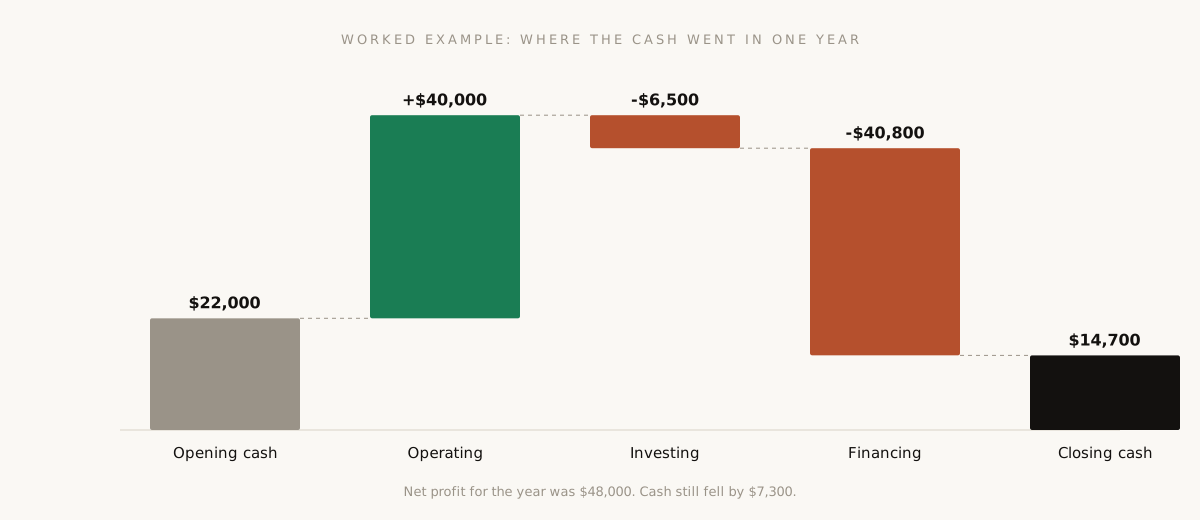
Operating activities: $48,000 of profit became $40,000 of cash. The biggest gap is the $12,000 increase in receivables. The studio did the work and sent the invoices, so the P&L counts the income, but the clients have not paid yet. Depreciation and unpaid bills worked the other way and added $5,000 back. Reading this section tells you the business is healthy at its core: it produces cash, just not as much as the profit suggests.
Investing activities: $6,500 on equipment. Nothing alarming. Subtract it from operating cash and you get free cash flow, the money left after the business has paid to keep itself running: $40,000 minus $6,500 is $33,500.
Financing activities: this is where the cash went. The owner drew $36,000 and repaid $4,800 of a loan. The draws alone were $2,500 more than the free cash flow, and the loan repayment took another $4,800. Together that is the $7,300 the bank balance fell by.
The reading: the business is profitable and produces cash, but the owner is paying themselves from the profit figure rather than the cash figure, and the gap is being covered by the savings in the account. At $14,700 the studio is still fine. Repeat the same year twice more and it is not.
Aziz's take: Pay yourself from free cash flow, not from profit. Profit includes money your clients still owe you, and you cannot spend an invoice. If you check one number on this statement every month, make it operating cash minus equipment, and keep your draws below it. That single habit would have kept the studio in the example from slowly running down its own cushion.
Direct vs Indirect: Why Some Statements Start With Profit
The example above uses the indirect method: it starts with net profit and adjusts it for everything that was not cash, such as depreciation and the change in what clients owe. The alternative, the direct method, lists the cash itself: cash received from customers, cash paid to suppliers, cash paid for rent. IAS 7 allows either for the operating section.
Both arrive at the same net cash from operating activities, and the investing and financing sections look the same either way. If your statement opens with net income, it is the indirect method, and the adjustment lines are where the useful information sits: each one is a reason your cash and your profit differ.
Cash Flow Statement Red Flags
None of these is fatal on its own in a single period. Each one becomes a problem when it repeats.
- Operating cash below profit, every period. One year like the example is normal. Three years in a row means the profit is sitting in receivables or stock and never arriving.
- Negative operating cash with a positive profit. The business looks profitable and is consuming cash. It is the pattern that sinks profitable small businesses, and managing cash flow is the fix.
- Receivables growing faster than sales. Clients are taking longer to pay. Visible as a large negative "increase in accounts receivable" line.
- Financing covering operations. New loans or owner money arriving in the same periods operating cash is negative. The business is being funded, not running.
- Selling equipment to raise cash. A positive investing section in a small business usually means assets are being sold to fill a gap.
- Draws above free cash flow. The owner is taking out more than the business produces, as in the example. Fine for a year with savings behind it, not as a habit.
Aziz's take: The adjustment lines are the part people skip, and they are the only part that explains anything. Net profit and closing cash you could get from the P&L and the bank. The lines in between are the reasons, and a reason is something you can act on.
How to Check Your Cash Flow Statement Is Correct
Three checks catch almost every error, and none of them needs an accountant.
- Closing cash matches the bank. The closing balance should equal your reconciled bank balances, and the cash line on your balance sheet, on the same date. If it does not, a transaction is missing or miscategorised.
- Opening cash matches last period's closing cash. If the two differ, something was changed after the last period was closed.
- The sections add up. Operating plus investing plus financing equals the net change in cash, to the dollar.
The commonest real error is a categorisation one: an owner's draw booked as an expense, or a loan repayment booked entirely as a cost. Both distort profit and push cash into the wrong section, which is why the small business finance guide treats clean categories as the foundation everything else rests on.
What Is Considered a Good Cash Flow?
For a small business, three things together describe a healthy statement. Operating cash is positive. Over a full year it is roughly in line with profit, not persistently below it. And free cash flow, operating cash minus what you spend on equipment, covers what you pay yourself and any loan repayments without drawing down the balance year after year.
A single negative month is not a verdict. Seasonal businesses swing, and a large equipment purchase can turn a good quarter negative on paper. Read the trend across several periods, and read each section separately, because "cash went down" means something very different when the cause is a new laptop than when it is clients not paying.