On this page
Problem-solution fit means you have evidence that a specific group of people has a problem painful enough to act on, and that your proposed solution is something they would actually use or pay for. It comes before product-market fit: you prove the problem and the appetite for a fix before you build the full product. To test it, write the problem as one sentence about a specific person, interview 10 to 15 people who have it about what they did the last time it happened, look for what they already spend time or money on to work around it, and only then show your solution and ask for a small commitment such as a pre-order, a deposit or a paid pilot. Set your pass mark before you start. Three worked examples below show what passing and failing look like.
Most products that fail were not built badly. They were built for a problem that was real but not painful enough for anyone to pay to fix. Problem-solution fit is the check that catches that before you have spent six months building.
This guide covers what problem-solution fit means, a six-step way to test it, how it differs from product-market fit, three worked examples, the canvas some founders use to organise it, and the mistakes that produce false positives.
What Does Problem-Solution Fit Mean?
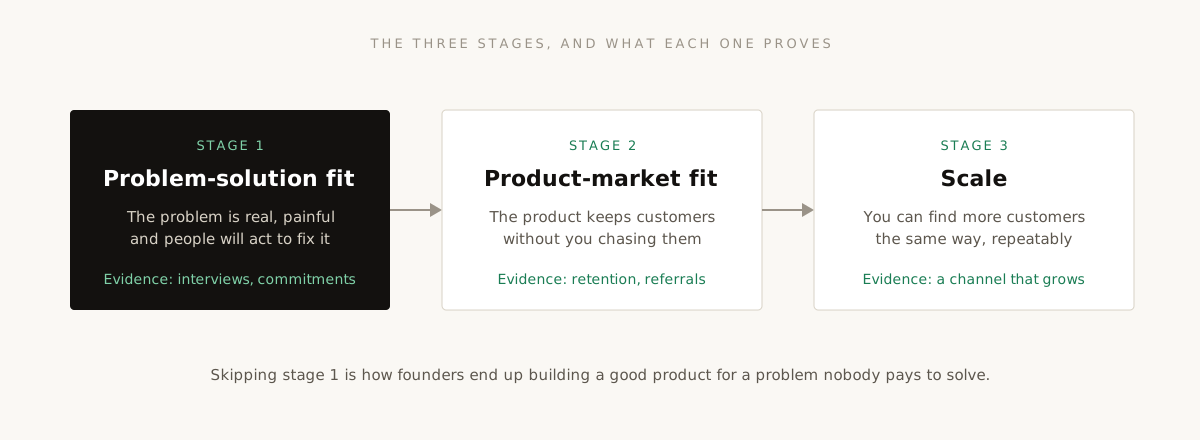
Problem-solution fit is the first of three stages a product goes through. Ash Maurya, who wrote Running Lean, puts it plainly: every product goes through problem/solution fit, product/market fit, and scale. The first stage asks two questions. Is the problem real and painful for a group you can name? And would your solution change what they do about it?
You have it when you can show evidence for both, not opinions. Evidence means things people have done: what they already pay for, what workarounds they have built, and whether they commit something, money or time, when you describe your solution.
How to Test for Problem-Solution Fit in Six Steps
- Write the problem as one sentence about a specific person. Who has it, in what situation, and what it costs them. "Small businesses struggle with admin" is not testable. "Solo bookkeepers lose about a day a month chasing clients for missing receipts" is.
- Find 10 to 15 people who have it, and not your friends. Friends are polite. Strangers who match your sentence tell you what is actually true. Industry groups, forums and your existing contacts' introductions are the usual sources.
- Ask about the last time it happened, not about the future. "What did you do the last time a client sent receipts late?" gets a real answer. "Would you use an app for this?" gets a yes from almost everyone. Our guide on how to interview customers covers the questions in detail.
- Look for what they already spend on it. A spreadsheet they built, a tool they pay for, a person they hired, hours they lose. If nobody has tried to solve it, the problem may not hurt enough.
- Only then describe your solution, and ask for a small commitment. A pre-order, a deposit, a signed letter of intent, or agreeing to a paid pilot. A commitment that costs them something is the difference between interest and fit.
- Decide against a pass mark you set before you started. For example: at least 6 of 10 describe the problem without being prompted, and at least 3 agree to a paid pilot. Setting it in advance stops you reading every answer as a yes.
Aziz's take: The most useful sentence in a customer conversation is "tell me about the last time that happened." It moves the person from opinions to memory, and memory is where the real cost of a problem lives. If they cannot remember a last time, you have your answer.
Problem-Solution Fit vs Product-Market Fit
The two are often confused because both have "fit" in the name. They answer different questions at different times. Marc Andreessen, who popularised the second term, defined it in 2007 as being in a good market with a product that can satisfy that market.
| Problem-solution fit | Product-market fit | |
|---|---|---|
| Question | Is the problem real, and would this solution change what people do? | Does the product keep customers, and is the market big enough? |
| When | Before you build the full product | After launch, with real customers using it |
| Evidence | Interviews, existing workarounds, pre-orders or paid pilots | Retention, repeat purchases, customers arriving by referral |
| Typical cost | Weeks of conversations and a landing page | A working product and months of iteration |
How do you know when you have reached product-market fit? The usual signs are that customers keep using the product without being chased, new ones arrive through word of mouth, and usage holds up after the first month rather than fading. Until you see those, you are still testing. A minimum viable product is usually the bridge between the two stages.
Problem-Solution Fit Examples
Three illustrative examples, one that passes, one that fails, and one that passes only after the problem is narrowed.
| Receipt chasing for bookkeepers | Meal planning for busy parents | Booking for dog groomers | |
|---|---|---|---|
| Problem sentence | Solo bookkeepers lose a day a month chasing clients for receipts | Busy parents struggle to plan healthy meals | Mobile dog groomers lose bookings because they cannot answer the phone mid-groom |
| What interviews showed | 8 of 12 described it unprompted; most had a reminder spreadsheet | Most agreed it was a problem, but few could describe the last time it cost them anything | The first version ("scheduling is hard") was vague; asked about the last missed call, 7 of 10 had lost a booking that week |
| Existing spend | Hours each month, plus some paid for a generic reminder tool | Free apps tried and abandoned | Some paid a part-time person to answer calls |
| Commitment test | 4 paid for a three-month pilot | Many joined a waitlist, nobody pre-paid | 3 paid a deposit for a missed-call text-back service |
| Verdict | Pass | Fail: interest, not fit | Pass, after narrowing the problem |
The meal-planning example is the most common pattern. Everyone agrees the problem exists, which feels like validation, but nobody has acted on it and nobody commits. A waitlist full of people who will not pay is a polite no.
The groomer example shows why the problem sentence matters. "Scheduling is hard" produced vague answers. "Missed calls while my hands are full" produced specific, recent, costly ones, and a solution people would pay a deposit for.
The Problem-Solution Fit Canvas
The Problem-Solution Fit Canvas, created by Daria Nepriakhina of IdeaHackers, is a one-page way to organise what you learn. It works through four areas: the customer's current state, the problem and the behaviour it causes, the triggers, emotions and channels that reach them, and finally your solution.
Its value is the order. It makes you describe the customer and what they already do before you write anything about your solution, which is the same discipline as the six steps above. If you prefer a broader one-page plan that also covers pricing and channels, a lean canvas includes the problem and solution boxes alongside the rest of the business model.
What Goes Wrong
- Counting polite interest as fit. "That sounds useful" costs the person nothing to say. Only behaviour and commitments count.
- Asking about the future. People are bad at predicting what they would do and good at remembering what they did. Ask about the last time.
- Pitching too early. Once you describe your solution, people start reacting to it instead of telling you about their problem. Hold it until the end of the conversation.
- Talking only to friends and family. They want to support you. That makes their answers kind and useless.
- Moving the pass mark after the results. If 2 of 10 commit and you decide that is enough, the test did not test anything.
Aziz's take: A failed problem-solution fit test is a good result, not a bad one. It costs you a few weeks of conversations instead of months of building. The founders who struggle most are usually the ones who skipped this stage because they were sure, which is the same reason starting from the problem rather than the product tends to win.