On this page
A quality control checklist is a list of yes-or-no checks a piece of work must pass before it is accepted or handed over. A good one names the standard the work is checked against, places each check where a defect is cheapest to catch (on the inputs, during the work and at the end), gives every check a clear pass condition, and records who signed it off. The free quality control checklist template below covers all of that and works for a manufactured part, a job on site or a client deliverable. Copy it, or download it as a text file and paste it into Word, Excel or Google Sheets. After it: how to make your own in six steps, examples for construction, manufacturing and client work, how a QC checklist differs from a QA checklist and a 5S checklist, and the mistakes that make a checklist useless.
Most quality control checklists you will find are written for a factory line or a building site. The idea underneath works for any work you hand over: decide what "done right" means before the work starts, then check against it before the work leaves you.
The template below is built that way. It is generic on purpose, so it fits a part, a job or a report, with filled-in examples for each further down.
The Quality Control Checklist Template
How to use this
Fill in
- Every highlighted value. Nothing else needs changing.
- Write each check as a question with one right answer.
- Give every check a pass condition: a number, a tolerance or a reference to the spec.
Check before using
- Someone who did not do the work could answer every line.
- There is at least one check before the final inspection.
- A named person signs off, and it is not only the person who did the work.
What goes wrong
- "Looks good" as a check. Nobody can fail it, so it catches nothing.
- Checking only at the end, after the defect has been built on.
- A failed check gets noted and the work goes out anyway.
Rules that make it work
- The person who did the work does not sign off the final check alone.
- Every check has a pass condition someone else could verify.
- A failed check stops the work at that point. It is fixed and checked again, not noted and passed.
- Any defect that gets through becomes a new line on this checklist.
- The completed checklist is kept with the job record for 12 months.
Replace every highlighted value. The download is a plain text file, so it pastes cleanly into Word, Excel or Google Sheets.
What Is a QC Checklist?
A QC checklist is the inspection side of quality: the specific checks a piece of work must pass, at set points, before it moves on. The American Society for Quality describes quality control as the inspection aspect of quality management, as distinct from the process side.
Each line is a question with one correct answer and a pass condition. That is what makes it a checklist rather than a reminder: two different people checking the same work should reach the same result.
It is not only for products. ASQ notes that a service can include products that are documents, such as a report, a contract or a design, and those can be checked the same way. If you deliver work to clients, you already have something to inspect.
How to Make a QC Checklist
- Write down the standard first. The spec, the drawing, the order or the client's brief. A checklist without a standard is checking opinions.
- List the defects that actually happen. Go through recent returns, complaints, rework and client corrections. Those are your first checks, because they have already cost you.
- Turn each one into a yes-or-no check with a pass condition. "Dimensions correct" becomes "width 120 mm, plus or minus 1 mm". "Proofread" becomes "every figure matches the source table".
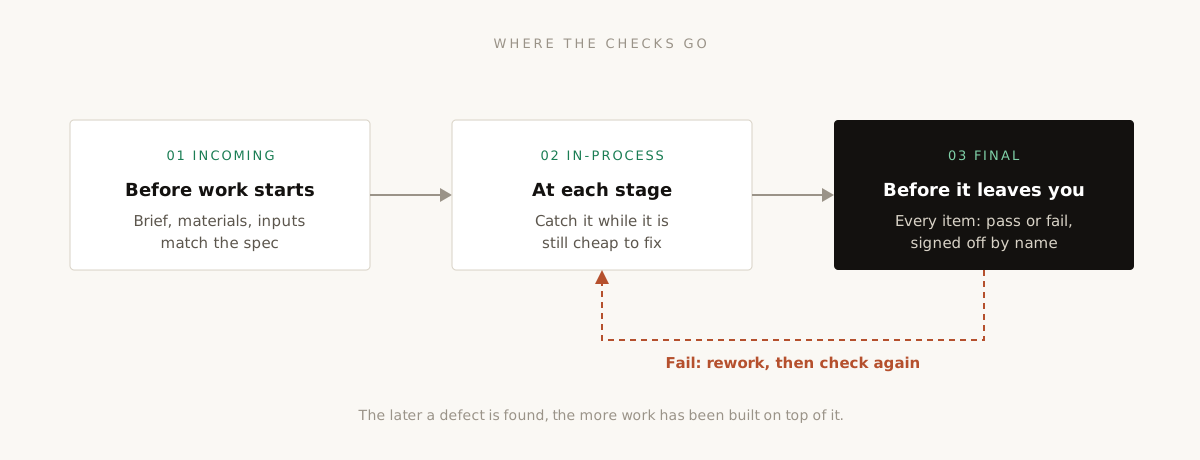
- Put each check where the defect is cheapest to catch. Some belong on the inputs before work starts, some at a stage during the work, the rest in the final inspection.
- Decide who checks, and what happens on a fail. Name the checker. A fail stops the work, the defect is fixed, and the same check is run again.
- Use it on the next job, then cut and add. Remove checks that never fail and cost time. Add every defect that got through.
Aziz's take: The best source for your checklist is your own mistakes, not someone else's template. Every correction a client has sent you is a check you should have had. Start with the generic list above, then spend ten minutes going through your last five pieces of rework and turn each one into a line.
Quality Control Checklist Examples
The structure stays the same across industries. What changes is the checks inside each stage. Here is the same checklist filled in three ways.
| Stage | Construction | Manufacturing | Client work |
|---|---|---|---|
| Incoming | Materials delivered match the order and spec sheet; drawings are the current revision | Material certificates match the purchase order; the first part is checked against the drawing before the run starts | Brief confirmed in writing; source files and data are the latest version |
| In-process | Each stage inspected before it is covered up by the next one | Samples checked at set intervals during the run | Draft reviewed at the agreed checkpoint before the full build |
| Final | Work matches the drawings; snag list walked with the client; site cleared | Dimensions within the tolerance on the drawing; labelling and packaging correct; quantity counted | Every point in the brief met; figures match the source; links and files open; formatted to the client's standard |
| Sign-off | Signed by the site lead and accepted by the client | Batch released by whoever owns quality, record kept | Checked by someone other than the author where possible, delivered with a version number |
Notice the in-process row. In every industry it is the check people skip, and it is the one that saves the most work: a wall inspected before it is plastered, a run sampled before a thousand parts are made, a draft reviewed before the whole report is written.
QA vs QC Checklist: What Is the Difference?
Quality assurance is about the process. Quality control is about the output. ASQ puts it as quality assurance relating to how a process is performed or a product is made, while quality control is the inspection of the result.
| QA checklist | QC checklist | |
|---|---|---|
| Checks | The process: is the work being done the right way? | The result: does this piece of work meet the standard? |
| When | Before and during the work, and in periodic reviews | At set checkpoints, on every job |
| Example line | Is the current procedure being followed? | Is the width 120 mm, plus or minus 1 mm? |
| Job | Prevents defects | Catches defects |
A small business usually needs both, and they work best as a pair. The process itself belongs in a standard operating procedure; the QC checklist checks what that procedure produces. When the same check keeps failing, the fix is usually in the procedure, not in more checking.
What Is a 5S Checklist?
5S is a method for keeping a workspace organised, and a 5S checklist audits the workspace rather than the product. According to ASQ's 5S tutorial, it comes from the Toyota Production System and its five steps are sort, set in order, shine, standardize and sustain.
- Sort (seiri): anything not needed for the work is removed.
- Set in order (seiton): everything needed has a fixed, labelled place.
- Shine (seiso): the area is cleaned and inspected.
- Standardize (seiketsu): the first three are done the same way every time.
- Sustain (shitsuke): it happens without anyone being told.
It sits next to a QC checklist rather than replacing it. An organised workspace makes defects less likely; the QC checklist confirms whether one got through anyway. ASQ lists data and files among the things to sort, so the same idea applies to a shared drive as much as to a workshop.
What Goes Wrong
- Checks with no pass condition. "Looks good" and "quality OK" cannot fail, so they catch nothing. Every line needs a number, a tolerance or a reference.
- Checking only at the end. By the final inspection, a defect from the first stage has had everything else built on top of it.
- The person who did the work signs off alone. You read what you meant to do, not what you did.
- A fail gets recorded and the work goes out anyway. At that point the checklist is paperwork, not control.
- The checklist never changes. Defects that get through should become new lines. A checklist that is the same a year later has stopped learning.
- It is too long to finish. A long list gets skimmed, and a skimmed check is worse than no check because it signs off what nobody looked at.
Aziz's take: If you work alone, the hardest rule is the second pair of eyes. You cannot fully check your own work the moment you finish it. Leave a gap between finishing and checking, even an hour, or swap final checks with someone else who works on their own.
A QC checklist is one piece of running the business on systems rather than memory, and the business operations guide covers the rest. If someone else does the work for you, how to outsource tasks without losing quality covers the handover, and a runbook is where the checklist lives so it gets used every time.